
Your garden should feel like a retreat, not a fishbowl. If you've ever abandoned a sunny afternoon outside because a neighbour's upstairs window overlooks your entire patio, you already know the frustration. The right pergola privacy ideas shouldn't just block the view; they should transform your outdoor space into something that genuinely feels like an extra room, one you actually want to spend time in, whatever the weather.
And here's the thing most guides get wrong: privacy doesn't have to mean boxing yourself in. The best modern solutions give you control, the ability to open up when you want light and airflow, and close off completely when you want seclusion. That balance is exactly what we're covering here.
In this article, you'll discover the most effective and stylish ways to create a secluded garden sanctuary in 2026, from modular side screens and wind blinds to decorative panels that add genuine kerb appeal. Whether you're starting from scratch or upgrading an existing structure, these ideas will help you build an outdoor space that's private, weather-resistant, and unmistakably modern.
Key Takeaways
- The best pergola privacy ideas give you control over your seclusion, letting you open up for airflow and close off completely when you need it, rather than permanently boxing you in.
- Choosing between permanent fixtures like decorative panels and adjustable solutions like wind blinds depends on your garden's specific sun, wind, and overlooking angles, and this guide walks you through both.
- A 'living wall' approach combining aluminium trellises with climbing plants, and a louvered cocoon using adjustable side screens, are two of the most stylish and practical transformations you can make in 2026.
- Precision-fit privacy screens designed specifically for aluminium pergola frames outperform generic alternatives in both durability and appearance, and Pergola2Go's modular system is backed by a 10-year structural warranty.
- Before buying anything, mapping where overlooking actually occurs and measuring your pergola posts correctly will save you time, money, and the frustration of a poor fit.
Why Privacy is the Foundation of Modern Outdoor Living
Something significant has shifted in how we think about gardens. A decade ago, the aspiration was a well-kept lawn and a decent set of garden furniture. Today, the ambition is entirely different: a fully functional outdoor room, one that offers the same comfort, atmosphere, and sense of refuge as your best interior space. Privacy isn't an optional extra in that vision. It's the prerequisite that makes everything else possible.
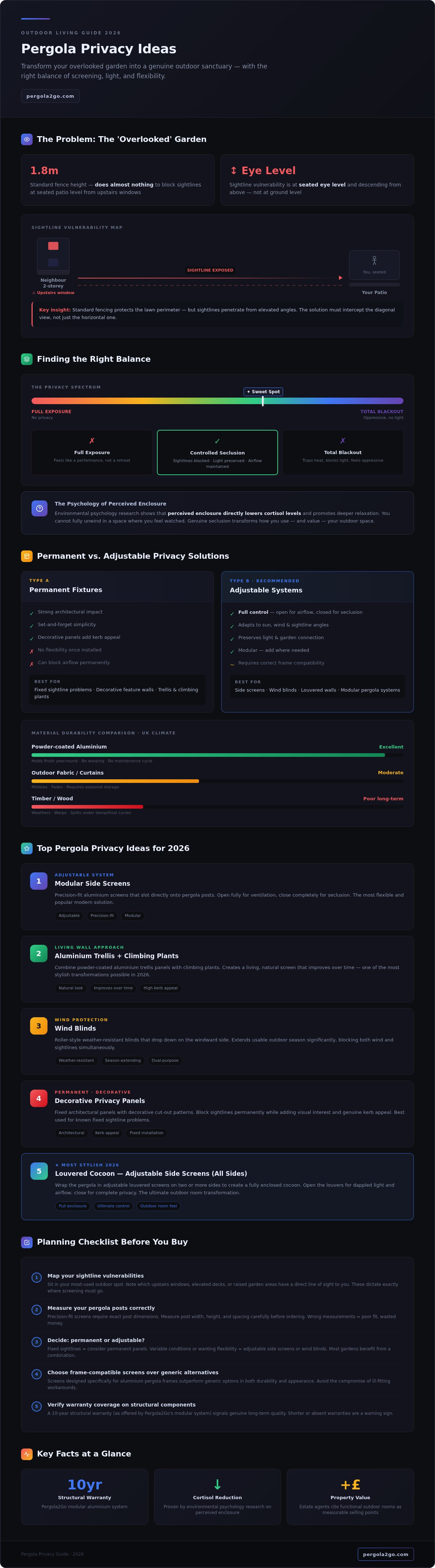
There's real psychology behind this. Research in environmental psychology consistently shows that perceived enclosure, the feeling of being sheltered and unseen, directly lowers cortisol levels and promotes deeper relaxation. Put simply, you can't fully unwind in a space where you feel watched. A garden that's open to neighbours' sightlines will always feel like a performance, not a retreat. The moment you create genuine seclusion, the space transforms. Conversations become easier, evenings feel longer, and you actually use the space you've invested in.
This is exactly why the most effective pergola privacy ideas aren't just about blocking views. They're about strategically placing vertical elements to intercept sightlines while preserving the airflow, natural light, and connection to the garden that make outdoor living worthwhile. The goal is control, not confinement.
The Problem of the 'Overlooked' UK Garden
UK housing density has made this challenge acute. In many suburban streets, a two-storey neighbour's window sits at precisely the angle to overlook a seated patio area, even when standard boundary fencing is in place. Traditional 1.8-metre fencing protects your lawn but does almost nothing for the zone directly beneath a pergola or around outdoor seating. The sightline vulnerability isn't at ground level; it's at eye level when you're sitting down, and it descends from above.
Identifying where you're actually exposed is the first practical step. Stand or sit in your most-used outdoor spot and note which upstairs windows, elevated decks, or raised garden areas have a direct line of sight to you. These are your sightline vulnerabilities, and they dictate exactly where vertical screening needs to go.
Privacy vs. Seclusion: Finding the Right Balance
Total blackout isn't the answer for most gardens. Solid walls block light, trap heat, and can make a space feel oppressive rather than intimate. The sweet spot sits between complete exposure and full enclosure: enough screening to eliminate unwanted sightlines, while still allowing dappled light, natural ventilation, and a sense of connection to the wider garden.
This is where garden pergolas become the structural anchor for your entire privacy strategy. Rather than treating screening as a retrofit afterthought, a well-chosen pergola gives you a precision frame onto which adjustable side screens, decorative panels, and wind blinds can be added exactly where they're needed. You're not building walls; you're engineering seclusion with flexibility built in.
From a property perspective, that distinction matters. Outdoor spaces that feel genuinely usable add measurable value to a home. Estate agents increasingly reference functional outdoor rooms, not just garden size, as a selling point. Effective pergola privacy ideas don't just improve how you live now; they improve what your property offers long-term.
Comparing Permanent vs. Adjustable Privacy Solutions
Not all privacy solutions are created equal, and the choice between static and dynamic options shapes how you'll actually experience your outdoor space day to day. Permanent fixtures offer a set-and-forget simplicity with strong architectural impact. Adjustable systems give you something more valuable: control. Understanding the trade-offs between the two is what separates a well-planned garden sanctuary from one that looks great in photographs but frustrates you in practice.
The material question matters enormously here, particularly in the UK climate. Wood weathers, warps, and splits under repeated cycles of damp and frost. Fabric outdoor curtains mildew, fade, and require seasonal storage. Powder-coated aluminium, by contrast, holds its finish and structural integrity year after year without the annual maintenance cycle that wooden alternatives demand. That's not a minor convenience; it's a fundamental difference in long-term value.
Integrated Wind Blinds: The Gold Standard
Track-guided wind blinds represent the most sophisticated approach to adjustable pergola privacy. Unlike loose outdoor curtains that billow and bunch in a breeze, track-mounted blinds run in precision channels fixed directly to the pergola frame, creating a taut, architectural finish that looks genuinely built-in rather than bolted on. You get full-width coverage when you need it, and a completely open aspect when you don't.
The dual benefit is what sets them apart from every other option. Wind blinds don't just block sightlines; they also intercept light rain and deflect wind, extending the usable season of your outdoor space well into autumn. Aluminium-framed blinds designed specifically for pergola systems hold their tension and shape far better than fabric-only alternatives, which sag and distort over time. For anyone serious about year-round outdoor living, they're the logical first investment.
Decorative Panels and Fixed Screens
Where adjustability isn't the priority, fixed screening solutions deliver a level of architectural polish that movable systems can't match. Laser-cut aluminium decorative panels introduce pattern, texture, and genuine visual interest to a pergola's sides, functioning as art as much as privacy screening. Fixed louvred panels offer a more utilitarian elegance: by setting the louvre angle during installation, you can intercept specific sightlines from neighbouring windows while still allowing air circulation and diffused light to pass through.
The key advantage of fixed aluminium panels over timber equivalents is longevity without maintenance. No repainting, no treating, no replacing warped boards after a harsh winter. For a deeper comparison of materials and configurations, the garden pergola with sides guide covers the full spectrum of options in detail.
When evaluating your own pergola privacy ideas, the honest cost-benefit calculation favours integrated aluminium systems over DIY add-ons. Generic screening attached to a non-matching frame rarely fits cleanly, often requires workarounds, and tends to look exactly like what it is: an afterthought. Modular accessories designed to fit a specific aluminium frame, and backed by a 10-year structural warranty, deliver a finish and durability that generic alternatives simply can't replicate over time.
If you're ready to explore which combination suits your space, Pergola2Go's modular wind blinds and decorative panels are engineered to integrate directly with their aluminium pergola frames, no compromises required.
Top Pergola Privacy Ideas for Your Garden Transformation
Knowing you need privacy is one thing. Knowing exactly which approach will work for your specific garden is another. These four ideas move from concept to execution, giving you a clear picture of what each solution looks and feels like in practice, and why certain combinations outperform others.
Idea 1: The 'Living Wall'
An aluminium trellis panel fixed to your pergola frame becomes the backbone of a living privacy screen when paired with the right climbing plants. The structure does the immediate work of blocking sightlines; the plants do something more interesting over time, softening the clean geometry of powder-coated aluminium into something that feels genuinely organic.
Not all climbers are equal partners for a metal frame. The best choices for UK gardens include:
- Jasmine (Trachelospermum jasminoides): Evergreen, fragrant, and dense enough to provide year-round coverage once established.
- Clematis: Fast-growing with exceptional coverage; choose a variety like 'Jackmanii' for reliable vigour.
- Hydrangea petiolaris: A climbing hydrangea that thrives against a shaded or north-facing side, filling gaps where other climbers struggle.
Pair the trellis with large, heavy planters positioned at the base of each pergola post. Beyond the planting benefit, weighted planters add a secondary layer of low-level screening and visually anchor the structure to the ground, making the whole arrangement feel deliberate rather than improvised.
Idea 2: The 'Louvered Cocoon'
Adjustable side louvres are the most precise of all pergola privacy ideas because they let you intercept specific sightlines without closing off the entire side of the structure. Rotate the louvres to block an upstairs window to the left while keeping the view into your own garden completely open. It's directional privacy, engineered rather than guessed at.
This approach works especially well in gardens where the overlooking angle is consistent, typically a single neighbour's window rather than a panoramic exposure. Fitting louvred side screens on two or three sides creates a genuinely cocoon-like atmosphere without the claustrophobia of solid walls.
Idea 3: The 'Textured Retreat'
Mixing materials creates depth that a single-solution approach simply can't achieve. Solid decorative aluminium panels on the most exposed side deliver complete opacity where you need it most. Translucent wind blinds on the remaining sides filter light rather than blocking it, maintaining a sense of openness while still obscuring the view from outside. The contrast between solid and translucent elements also adds genuine visual texture, making the pergola feel like a considered architectural feature rather than a functional box.
Idea 4: The 'Corner Seclusion'
Full enclosure isn't always the goal. Screening just two sides of a pergola, typically the two that face neighbouring properties, preserves an open view into your own garden while eliminating the sightlines that actually compromise your comfort. This is the right strategy when you have a garden worth looking at. It keeps the space feeling expansive while solving the specific problem.
Strategic Plant Integration
The practical detail most guides skip: aluminium frames require a slightly different approach to plant training than timber. Use soft ties rather than wire to attach stems to the frame, avoiding any risk of abrasion against the powder-coated finish. Space your initial planting closer than you think necessary; climbers look sparse in their first season but fill out quickly once the root system establishes.
Lighting for Evening Privacy
Daytime privacy is straightforward. Evening privacy is where most gardens fail. Once it's dark outside and your pergola is lit from within, you become entirely visible to anyone outside. The solution is deliberate light placement rather than simply adding more brightness.
An LED lighting kit integrated into the pergola frame lets you position light sources to illuminate decorative panels and structural elements, creating visual interest on the outside while keeping your seating area in softer, lower-level light. The effect is a 'light curtain': the exterior of the pergola glows attractively, but the interior remains comfortably shadowed. For creative layouts that combine ambient, accent, and task lighting within a single pergola structure, the pergola decorating ideas guide covers the full range of approaches in detail.
Layering these pergola privacy ideas is where the real transformation happens. A louvered side screen handles the daytime sightline problem; a well-placed LED kit handles the evening one. Together, they give you a space that works at every hour, not just between 10am and dusk.
Planning and Installing Your Pergola Privacy Screens
Good intentions and poor planning produce the same result: screens that sag, gaps that defeat the purpose, and fixings that fail after the first serious storm. Before you commit to any of the pergola privacy ideas covered in this guide, a methodical planning process will save you significant time and money. Four steps make the difference between a professional finish and an expensive frustration.
Step 1: Map your sun and wind before anything else. Spend time in your garden at different points in the day and note where the sun tracks, where wind channels through, and, critically, where the overlooking angles sit. These three factors rarely align, which means your privacy solution on the south-facing side may need to be entirely different from the one facing your neighbour's upstairs window to the north. A screen that works beautifully in still conditions can become a structural liability if it's positioned directly in a wind corridor without the right fixing depth.
Step 2: Measure with precision, not approximation. Generic screening products fail because they're cut to standard sizes that rarely match real pergola post dimensions. Measure the clear span between posts at the top, middle, and bottom of the intended screen run. These three measurements often differ by more than you'd expect, particularly on older ground-level installations where posts have settled slightly. A screen that fits the top but not the bottom will gap, bow, and look exactly as careless as it is.
Calculate your required height based on two scenarios: the seated eye level of someone in your garden (typically around 1.1 to 1.2 metres from the deck surface) and the standing eye level of someone outside it. Effective screening addresses both, not just one.
Step 3: Inside mount versus outside mount. An inside mount fixes the screen between the pergola posts, creating a flush, integrated finish. An outside mount wraps over the post face, which is simpler to retrofit but adds visible bulk. For aluminium pergola frames, inside mounting almost always produces the cleaner result, provided your measurements are exact.
Step 4: Structural safety isn't optional. Third-party add-ons attached to a frame they weren't designed for introduce stress points at fixings that the original structure wasn't engineered to handle. Accessories designed specifically for an aluminium pergola frame distribute load correctly and maintain the structural integrity the frame was tested to deliver.
Measuring Your Space for Privacy Add-ons
The 'Three-Point Measurement' rule is straightforward: measure width at the top, centre, and bottom of the opening, then use the smallest figure as your screen width. This prevents any risk of the screen bowing outward under tension. For wind blind operation specifically, a clearance gap of at least 10mm between the bottom of the blind and the deck surface ensures the blind runs smoothly without catching or binding on the track.
Wind Resistance and Safety
The 'sail effect' is the single most underestimated risk in DIY privacy screening. A solid panel catches wind like a sail, transferring enormous lateral force directly into the fixings and posts. Perforated or louvred screens dissipate that force through the gaps, which is why they require less aggressive anchoring than solid alternatives. In exposed UK gardens, this distinction is the difference between a screen that survives a winter intact and one that becomes a projectile.
Powder-coated aluminium is non-negotiable for UK conditions. Steel fixings rust, weaken, and stain the surrounding material within a few seasons of coastal or high-rainfall exposure. Aluminium fixings and frames hold their integrity and their finish without the annual maintenance cycle that any other material demands.
Keep sliding tracks and channels clear of leaf debris, particularly before the autumn months when blockages are most likely. A quick wipe-down of the track with a dry cloth every few weeks is all it takes to keep manual and motorised elements running without resistance.
If you're ready to plan a precision-fit privacy solution for your aluminium pergola, explore Pergola2Go's modular side screens and wind blinds, designed from the ground up to integrate with their aluminium pergola frames and backed by a 10-year structural warranty.
The Pergola2Go Difference: Integrated Privacy Systems
There's a fundamental problem with the generic approach to pergola privacy: screens designed for no frame in particular fit no frame particularly well. Gaps appear at the edges. Fixings don't align with post positions. The finish never quite matches. The result looks like exactly what it is: a compromise. Pergola2Go was built around a different premise entirely, that privacy elements should be engineered alongside the structure they attach to, not sourced separately and hoped for the best.
That precision matters more than most buyers realise until they've experienced the alternative. When wind blinds are designed specifically for an aluminium pergola frame, the tracks align perfectly, the tension is correct from the first installation, and the aesthetic is coherent across every component. No adapters, no workarounds, no visible mismatches between a screen's finish and the post it's fixed to.
Our Modular Privacy Range
Pergola2Go's wind blinds and decorative panels are engineered as part of the same modular system as the pergola frame itself. Every component shares the same powder-coated aluminium finish, which means the colour and texture are consistent across the roof, posts, and any privacy additions you choose, whether you fit them at installation or add them two years later. That flexibility is the real advantage of a modular design. Your privacy needs can evolve with your garden without requiring a structural overhaul.
Buying a pergola with a roof and sides as a complete system removes the guesswork entirely. You get a structure where every element has been tested together, fits together, and looks like it was always meant to be there. That's the difference between a garden feature and a garden room.
Investment in Longevity
Timber privacy solutions have a predictable lifecycle in the UK climate: they look good for a season or two, then the damp gets in, the paint peels, and the boards start to warp. Within a few years, you're either repainting, treating, or replacing. Aluminium has none of those vulnerabilities. It doesn't absorb moisture, it doesn't rot, and the powder-coated finish holds its colour without any seasonal maintenance. No painting. No staining. No rot-treatment. Ever.
That's the zero-maintenance promise built into every Pergola2Go structure, and it's backed by a 10-year structural warranty that covers your privacy investment alongside the frame itself. When you're evaluating pergola privacy ideas, that warranty is the clearest signal of engineering confidence available. It means the screens, panels, and blinds aren't afterthoughts; they're guaranteed components of a system designed to last.
For anyone serious about creating a genuinely private, weather-resistant outdoor space that requires nothing from you beyond the occasional wipe-down, the case for aluminium over timber is straightforward. The upfront investment pays for itself in the maintenance costs and replacement cycles you'll never face. Explore the Pergola2Go privacy collection and find the combination of wind blinds, side screens, and decorative panels that fits your garden layout precisely.
Your Private Garden Sanctuary Is Closer Than You Think
A garden you actually want to use every day isn't a luxury. It's the result of solving one specific problem: eliminating the sightlines that make you feel watched. The right pergola privacy ideas don't box you in; they give you control over when you're open and when you're secluded.
The key lessons from this guide are straightforward. Map your overlooking angles before you buy anything. Choose aluminium over timber if you want a solution that still looks sharp five winters from now. And prioritise integrated systems over generic add-ons; precision fit isn't a nice-to-have, it's what separates a polished result from a frustrating one.
Pergola2Go's aluminium kits are available in free-standing and wall-mounted configurations, ship nationwide from stock, and are backed by a 10-year structural warranty that covers your privacy additions alongside the frame itself. No maintenance cycles. No compromises on fit.
Reclaim your garden privacy with a Pergola2Go Aluminium Kit and start enjoying the outdoor space you've always wanted.
Frequently Asked Questions About Pergola Privacy Ideas
Do pergola privacy screens require planning permission in the UK?
Most pergola privacy screens fall within Permitted Development rights and don't require planning permission, provided the overall structure stays within standard height limits and sits within the boundaries of your property. The critical threshold is 2.5 metres for structures within 2 metres of a boundary. If your pergola already has planning approval, adding side screens or wind blinds to an existing structure rarely triggers a separate application.
That said, rules vary between local authorities, and properties in conservation areas or with Article 4 Directions face tighter restrictions. Always check with your local planning authority before installation if you're uncertain, particularly for structures close to boundary lines.
Can I add privacy sides to my pergola after it has been installed?
Yes, and with a modular aluminium system, retrofitting privacy additions is genuinely straightforward. Pergola2Go's side screens, wind blinds, and decorative panels are engineered to integrate directly with their aluminium pergola frames at any point after initial installation, so your privacy needs can evolve without requiring structural changes to the existing frame.
The main practical consideration is ensuring your post dimensions and span measurements are accurate before ordering. Measure at three points across each opening (top, centre, and bottom) and use the smallest figure. Aluminium modular systems designed for a specific frame will fit cleanly; generic aftermarket screens rarely do.
How do aluminium privacy panels handle high winds?
Powder-coated aluminium panels are significantly more wind-resistant than timber equivalents because they don't warp, bow, or lose structural integrity when repeatedly exposed to moisture and pressure cycles. Perforated and louvred aluminium panels dissipate wind force through their gaps rather than catching it like a solid sail, which reduces the lateral load transferred to fixings and posts considerably.
Solid panels in exposed positions carry a higher wind load, so correct fixing depth and post anchoring matter more in those configurations. If your garden sits in a particularly exposed position, louvred or track-guided wind blind options are a more practical choice than fully solid screening.
Will a privacy screen block out too much natural light?
It depends entirely on the screen type you choose. Solid decorative panels do reduce light on the screened side, but louvred panels and translucent wind blinds filter rather than block, letting diffused light pass through while still obscuring the view from outside. Positioning also matters: a screen on a north-facing side has far less impact on overall light levels than one facing south or west.
The most effective pergola privacy ideas use a mix of materials rather than a single solution across all sides. A solid panel where you need complete opacity, paired with a translucent or louvred option elsewhere, gives you seclusion without turning your outdoor space into a shaded box.
What is the best material for a pergola privacy wall in the UK?
Powder-coated aluminium is the strongest performer for UK conditions, and it's not particularly close. Timber looks attractive initially but requires regular treating, painting, and eventual board replacement as damp and frost cycles take their toll. Fabric screening fades, mildews, and needs seasonal storage. Aluminium holds its finish and structural integrity year after year with no maintenance beyond an occasional wipe-down.
For anyone investing in a long-term outdoor space, the total cost of ownership calculation favours aluminium clearly. The upfront cost is offset by the maintenance cycles and replacement costs you'll never face, and a 10-year structural warranty provides genuine reassurance that the investment is protected.
Can I use climbing plants on an aluminium pergola for privacy?
Climbing plants work beautifully on aluminium pergola frames, provided you use the right attachment method. Use soft ties rather than wire to train stems against the frame; wire can abrade the powder-coated finish over time and create moisture-trapping contact points. Aluminium trellis panels fixed to the frame give climbers a structured surface to grip without relying on the frame itself as the primary support.
Jasmine, clematis, and climbing hydrangea are all reliable choices for UK gardens. Plant closer together than feels necessary in the first season; climbers look sparse until their root systems establish, then fill out quickly. Heavy planters at the base of each post anchor the arrangement visually and add a useful secondary layer of low-level screening.
How do I clean and maintain my pergola wind blinds?
Aluminium-framed wind blinds need very little from you. Wipe down the tracks and channels with a dry cloth every few weeks, particularly in autumn when leaf debris accumulates and can cause the blind to bind or run unevenly. The blind surface itself responds well to a mild soapy water solution and a soft cloth; avoid abrasive cleaners that could dull the finish.
Check that the track fixings remain tight at the start of each season, especially after a harsh winter. Beyond that, there's no painting, no treating, and no seasonal storage required. That zero-maintenance reality is one of the most practical advantages aluminium wind blinds hold over fabric curtain alternatives.
Are motorised privacy screens better than manual ones?
Motorised screens offer genuine convenience, particularly on larger pergola spans where operating a full-width blind manually becomes awkward. The ability to adjust privacy levels from a phone or wall switch is also a meaningful upgrade if your pergola is used frequently throughout the day as sightline needs shift with the sun's position.
Manual systems are simpler, have fewer components that can require attention over time, and cost less upfront. For most standard-sized pergolas, a well-designed manual track system operates smoothly with minimal effort. The honest answer is that motorisation is worth the additional investment if your pergola is large or if ease of daily use is a priority; for smaller structures, a quality manual system delivers the same privacy result at lower cost.


