

The most expensive pergola you'll ever buy is the one that's ten centimetres too small for your chairs to pull back comfortably. Many homeowners focus solely on the footprint of their furniture, but a truly luxurious outdoor space requires a deeper understanding of scale and movement. When you begin asking "what size pergola do I need", you're not just looking for a roof; you're designing an environment that must balance aesthetic impact with practical daily use. It's a delicate dance between creating an intimate sanctuary and ensuring your structure doesn't overwhelm a compact UK patio.
We understand that the transition from a simple garden to a professional-grade outdoor living area can feel daunting. You want the certainty that your investment will fit perfectly within your boundary lines while providing the year-round utility you crave. This 2026 guide provides the clarity you need to choose with confidence. We'll explore the essential 1-metre clearance rule, explain how to stay within the 2.5m height limit for boundary-side installations, and show you how to map out activity zones that turn a standard aluminium pergola into a seamless extension of your home.
Key Takeaways
- Master the "Activity Zone" framework to ensure your new structure perfectly balances your furniture footprint with essential garden circulation.
- Avoid the common mistake of a cramped terrace by allowing an extra 50-70cm of clearance behind every dining chair for comfortable movement.
- Learn the technical nuances of UK Permitted Development, including the critical 2.5-metre height restriction for installations near property boundaries.
- Identify the ideal dimensions for your lifestyle, whether you're seeking a compact 3m x 3m aluminium sanctuary or a universal 3m x 4m entertaining space.
- Gain the confidence to answer "what size pergola do I need" by understanding how to balance structural scale with your garden's existing landscape.
Choosing the Right Pergola Size: More Than Just Square Metres
Visualizing a structure is often harder than it looks on paper. You might measure your patio and think a 3m x 3m model is plenty, but the "Scale Paradox" often strikes once the posts are bolted down. Vertical structures change how we perceive volume. A flat drawing doesn't account for how the roofline interacts with your house or how the posts frame your view. Understanding what is a pergola? and how it functions as an architectural anchor is the first step in answering "what size pergola do I need" for your specific plot.
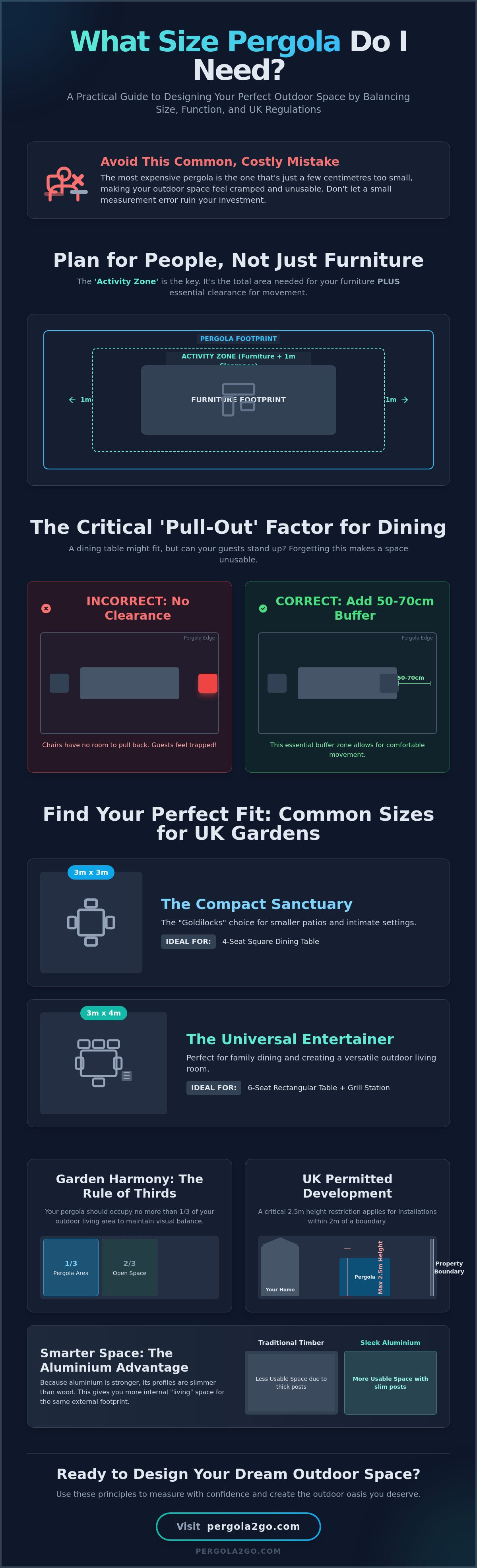
Balance is everything. In a typical UK garden, we recommend the "Rule of Thirds" to maintain a sense of harmony. Your pergola should ideally occupy no more than one-third of your total outdoor living area. This ratio ensures you have enough room for circulation while maintaining a clear distinction between your covered sanctuary and the open garden. If the structure is too large, it swallows the landscape. If it's too small, it looks like an afterthought. Post thickness also plays a psychological role. Sleek, engineered aluminium posts provide a sense of refined strength without the visual "heaviness" of traditional timber, making the space feel more open and airy.
The 'Shrinking Yard' Effect
Adding height to a garden changes your perspective. When you introduce a roof, your eyes focus on the new "ceiling" rather than the horizon. This can make a small yard feel even more intimate, which is great for privacy but risky for movement. Before you commit to a size, use masking tape or string to "ghost" the footprint on your patio. Walk through the space. Pull out the chairs. Check the sightlines from your kitchen window to ensure the posts don't block your favourite view of the flowerbeds. It's much easier to adjust a string line than a bolted base plate.
Aspirational Luxury vs. Practical Footprint
We all want that grand, sprawling outdoor lounge seen in luxury magazines. However, UK properties often require a more surgical approach to sizing. Choosing an aluminium pergola gives you a distinct advantage here. Because aluminium is incredibly strong, the profiles are significantly slimmer than wooden beams. This means you get more internal "living room" for every square metre of external footprint. When calculating your needs, always start with the "Activity Zone". An Activity Zone is the total area required for your furniture plus 1 metre of walk-around clearance on all sides. Focusing on this internal requirement ensures your lifestyle dictates the size, not just the available floor space.
The Activity Zone Framework: Matching Dimensions to Lifestyle
The most common design flaw in British gardens is neglecting the 'Pull-Out' factor. A dining table for six people might only be 1.8 metres long, but once you account for guests sliding their chairs back to stand up, you need an additional 50 to 70cm of clearance on all sides. Without this buffer, your sanctuary feels cramped. If you're working with a 4m x 3m footprint, you can comfortably house a medium dining set and a compact grill station, provided you plan the circulation paths carefully. While you're mapping out these dimensions, it's also wise to review UK planning permission rules to ensure your layout stays within legal height and boundary limits.
Sizing for the Perfect Outdoor Dining Room
For a standard 4-seat square table, a 3m x 3m pergola is the "Goldilocks" zone. It provides just enough room for the table and essential chair clearance without overwhelming a smaller patio. If you upgrade to a 6-seat rectangular set, a 3m width remains effective, but you'll need at least 4m of length to avoid blocking the walk-around space. Remember to leave a dedicated corner for an infrared heater. This ensures your dining room stays inviting well into the autumn evenings without encroaching on the seating area.
Designing a Lounge Sanctuary
Large L-shaped corner sofas require a surprisingly generous footprint to avoid feeling "stuffed" into a corner. A 4m x 4m or 3m x 4m structure is ideal for creating a true lounge sanctuary that feels open and airy. If you plan to include a fire pit, ensure it's positioned centrally under the louvered roof with ample clearance from any side screens. You can use integrated LED lighting kits to define the borders of this zone. This creates a soft, sophisticated glow that signals the transition from the open garden to your private retreat.
Exploring our range of precision-engineered aluminium pergolas will help you visualize how these functional zones come to life in your own garden.
Common Pergola Dimensions: What Fits in a 3m, 4m, or 6m Space?
Moving from the concept of activity zones to actual dimensions is where your project begins to take shape. In the UK market, sizes are typically standardized to fit the architecture of our homes and gardens. When deciding "what size pergola do I need", you should look at the most common metric footprints to see which aligns with your patio. Modern aluminium engineering allows for impressive spans that remain structurally sound without the need for excessive support posts, keeping your view clear and your floor space open.
Scale is a functional choice. A 3m x 3m structure serves a different purpose than a 6m grand entertaining space. You must also consider UK permitted development rights for outbuildings when selecting your dimensions. For instance, if you place a larger structure within 2 metres of your boundary, you must ensure the height doesn't exceed 2.5 metres to remain within legal limits. This regulatory framework often dictates the placement and total footprint of your installation. You should also remember that your total garden buildings cannot exceed 50% of your total garden area.
Small Garden Solutions (3m x 3m)
The 3m x 3m footprint is a masterpiece of efficiency. It's the perfect size for a cosy bistro set, a reading nook, or as a dedicated cover for a hot tub. If floor space is at a premium, wall mounted pergolas are an excellent choice as they utilize your house wall for support, effectively extending your indoor living room outward. You can add decorative panels to these smaller models to create a sense of privacy without making the area feel "boxed-in" or dark. It provides a professional-grade sanctuary even in the most compact urban terrace.
The Family All-Rounder (3m x 4m to 4m x 4m)
This is the "Universal" size for the UK. It fits the typical width of a semi-detached garden patio perfectly. A 3m x 4m model offers enough versatility to house a full dining set for six people alongside a compact barbecue station. It provides a balanced aesthetic that feels substantial without dominating the entire garden landscape. Many homeowners choose a garden pergola with sides in this size to create a weather-proof pod that's usable even when the British weather turns. It’s a permanent lifestyle upgrade that delivers immediate gratification for the whole family.
The Grand Outdoor Room (4m x 6m and Beyond)
For those with larger plots, a 4m x 6m structure creates a true outdoor room. This size can comfortably accommodate a full lounge suite and a separate dining area simultaneously. Thanks to modular aluminium kits, you can achieve these larger spans with precision-engineered strength. These systems often eliminate the need for middle posts, ensuring your entertaining space remains fluid and unobstructed. It's the ultimate statement of aspirational luxury, providing a transformation that feels both grand and inviting while maintaining the sleek, modern aesthetic of powder-coated aluminium.
Technical Clearances: Height, Boundaries, and Planning Permission
Precision engineering meets legal compliance in this final stage of your planning journey. When you begin to ask "what size pergola do I need", the answer is often dictated by the physical boundaries of your property as much as your lifestyle goals. Understanding the technical nuances of UK building regulations ensures your investment is permanent and protected. Most UK pergolas fall under Permitted Development if they remain under 2.5m tall within 2m of a boundary. This specific height restriction is designed to protect the light and privacy of neighbouring gardens, making it the most critical dimension to get right from the start.
Don't confuse your external footprint with your internal living space. A pergola sold as 3m x 4m refers to the outer edge of the roof or the post base plates. Because high-quality aluminium posts have a substantial profile for strength, you'll typically lose about 10 to 15cm of usable space on each side. If your dining table is exactly 3 metres long, it won't fit comfortably between the posts of a 3-metre wide model. Always factor in these internal clearances to ensure your furniture has the breathing room it deserves. You also need to allow for guttering and drainage. Ensure there's enough space around the structure for water runoff and basic maintenance access, especially if you're installing it close to a brick wall or a fence.
Height Considerations for Louvered Roofs
Your house architecture should dictate your post height. If you have out-swinging French doors or a low-set kitchen window, you must ensure the pergola beam doesn't obstruct their movement. Standard posts are usually 2.3m to 2.5m, but taller options are available for properties with high ceilings or grand entrances. Height also impacts your comfort levels. A taller roof allows for better airflow on hot days, but it can also change the effective throw of infrared heaters. To maintain that cosy, high-end lounge feel, you want your heat source to be close enough to be felt without being intrusive.
Boundary and Fence Clearances
Maintain good relations with your neighbours by considering sightlines and overshadowing. We recommend leaving at least a 50cm gap between your pergola posts and a shared fence. This provides enough room to install side screens and wind blinds without encroaching on the boundary line. It also makes it much easier to clean the aluminium frame or adjust your side panels in the future. By respecting these technical gaps, you create a professional-grade installation that feels like a natural, thoughtful extension of your home.
Ready to see how these dimensions fit your garden? Explore our full range of aluminium pergolas to find the perfect height and footprint for your property.
The Pergola2Go Solution: Modular Aluminium Kits for Any Space
Selecting the right material is just as vital as choosing the right dimensions. Powder-coated aluminium is the gold standard for UK gardens, offering a level of structural stability that timber simply cannot match. It doesn't warp, rot, or twist over time, ensuring your carefully measured clearances remain precise for decades. When you've spent time determining "what size pergola do I need", you want a structure that stays true to those measurements. Our modular kits provide this precision engineering, giving you the high-end look of a bespoke architectural build without the premium price tag or the long lead times.
Modular kits bridge the gap between expensive custom designs and flimsy temporary structures. Every component is manufactured to exact tolerances, ensuring the structural integrity of your 3m, 4m, or 6m span. This precision prevents the sagging often seen in traditional materials, keeping your louvered roof functioning flawlessly through every season. We back this confidence in our engineering with a 10-year structural warranty. It's a permanent lifestyle upgrade designed for immediate gratification, supported by nationwide delivery that moves your project from our warehouse to your garden with speed and efficiency.
Free-Standing vs. Wall-Mounted Sizing
Your choice between a wall-mounted or free-standing model will often dictate your final footprint. A wall-mounted pergola is a brilliant space-saver for compact UK patios. It anchors directly to your property, eliminating the need for two support posts and keeping your floor space clear for larger dining sets or garden kitchens. In contrast, a free-standing pergola acts as a bold architectural centerpiece. It’s the ideal solution for creating a dedicated "destination" zone in a larger landscape. You can customize either option with integrated LED lighting and heaters to define the atmosphere of your new sanctuary.
Ready to Measure Your Space?
Before you make your final selection, run through this checklist to ensure your garden transformation is a success. You don't need to be an architect to achieve a professional-grade result, but you do need to be thorough. If you're still asking "what size pergola do I need" for a unique corner of your garden, our experts are available for a sizing consultation to help you navigate the technical details.
- Furniture Footprint: Have you included the 70cm "pull-out" space for every dining chair?
- Circulation: Is there a clear 1-metre walkway around your primary activity zone?
- Height Clearance: Will the roof clear your out-swinging doors or low kitchen windows?
- Boundary Rules: Does your placement respect the 2.5m height limit for structures within 2m of a fence?
Browse our range of perfectly-sized aluminium pergolas and take the first step toward your elevated outdoor lifestyle today.
Elevate Your Outdoor Living Experience
Choosing the right dimensions is the foundation of a successful garden project. By prioritizing the 1-metre clearance rule and respecting the 2.5m boundary height restriction, you ensure your space is both functional and legally compliant. You no longer have to guess when asking "what size pergola do I need" because you now have the strategic framework to balance furniture footprints with your garden's unique scale. A well-planned footprint is the difference between a cramped patio and a true outdoor sanctuary.
Our precision-engineered kits offer the perfect blend of industrial durability and lifestyle elegance. Every structure is crafted from rust-resistant powder-coated aluminium and backed by a 10-year structural warranty for total peace of mind. With fast nationwide UK delivery, your professional-grade transformation is closer than you think. It's time to stop dreaming about the perfect space and start building it.
Find Your Perfect Fit: Shop Our Aluminium Pergola Kits
Take the leap and turn your patio into a year-round sanctuary today. Your property deserves a centerpiece that reflects your pride in ownership and your commitment to a more refined lifestyle.
Frequently Asked Questions
Do I need planning permission for a 3m x 4m pergola in the UK?
Generally, you won't need planning permission for a 3m x 4m pergola because it falls under permitted development rights. You must ensure the structure isn't positioned forward of the front of your house and doesn't cover more than 50% of your total garden area. If you place it within 2 metres of a boundary, the maximum height is strictly limited to 2.5 metres to remain compliant.
What is the most popular size for a garden pergola?
The 3m x 4m footprint is the most popular choice for UK homeowners seeking a balance between luxury and practicality. This "universal" size fits perfectly on the typical semi-detached patio while providing enough internal space for a dining set of six to eight people. It offers a professional-grade entertaining area that enhances property value without dominating the entire outdoor landscape.
How much space should I leave between my house and the pergola?
Leave a gap of at least 50cm to 1 metre if you are installing a free-standing model near your home. This clearance ensures you have enough room for maintenance access and allows for proper guttering drainage. If your goal is a seamless extension of your kitchen or lounge, choosing a wall-mounted pergola is the most efficient way to save floor space and eliminate house-side posts.
Can a pergola be too big for a small garden?
Yes, a structure can overwhelm a compact plot if it occupies more than one-third of your total outdoor living area. When you are determining what size pergola do I need for a smaller garden, focus on maintaining clear sightlines from your windows. Sleek aluminium frames are ideal here as their slim profiles provide structural strength without the visual "heaviness" that can make a small yard feel cramped.
What height should a pergola be for a hot tub?
A standard height of 2.5 metres is the ideal choice for most hot tub installations. This provides plenty of vertical room for cover lifters to function and ensures you can move in and out of the tub comfortably. If you plan to install your tub on a raised deck, remember that UK height regulations measure from the ground level, so factor in the platform's height first.
How do I measure my patio for a wall-mounted pergola?
Start by measuring the height of your external doors to ensure the mounting beam sits high enough for them to open fully. You need a clear, flat section of masonry for the wall bracket that is free from vents or pipes. Measure the total width of your patio and allow for at least 15cm of clearance on each side so the supporting posts sit securely on your paving.
Is a 3m x 3m pergola big enough for a dining table?
A 3m x 3m pergola is perfectly sized for an intimate four-seat dining set or a bistro arrangement. It provides just enough room for the table and the essential "pull-out" space for chairs. If you frequently host larger groups, you might find this footprint restrictive. When asking what size pergola do I need for family gatherings, a 4m length is usually the better investment.
Does the 2.5m height rule include the louvered roof when open?
The 2.5m height restriction applies to the highest point of the permanent structure at any time. To stay within permitted development rights near a boundary, you should ensure the top of the frame or the louvres in their most upright position does not exceed this limit. Measuring to the maximum extension of the louvres provides the certainty you need to avoid potential planning disputes with neighbours.


