

Your garden shouldn't be a seasonal guest that disappears at the first sign of a British drizzle. We've all felt the frustration of watching a perfectly good patio sit abandoned while the clouds roll in, or struggling to maintain high-maintenance wooden structures that rot in the damp. Creating a weatherproof outdoor living room is the definitive way to reclaim your square footage and turn your garden into a sophisticated, year-round sanctuary.
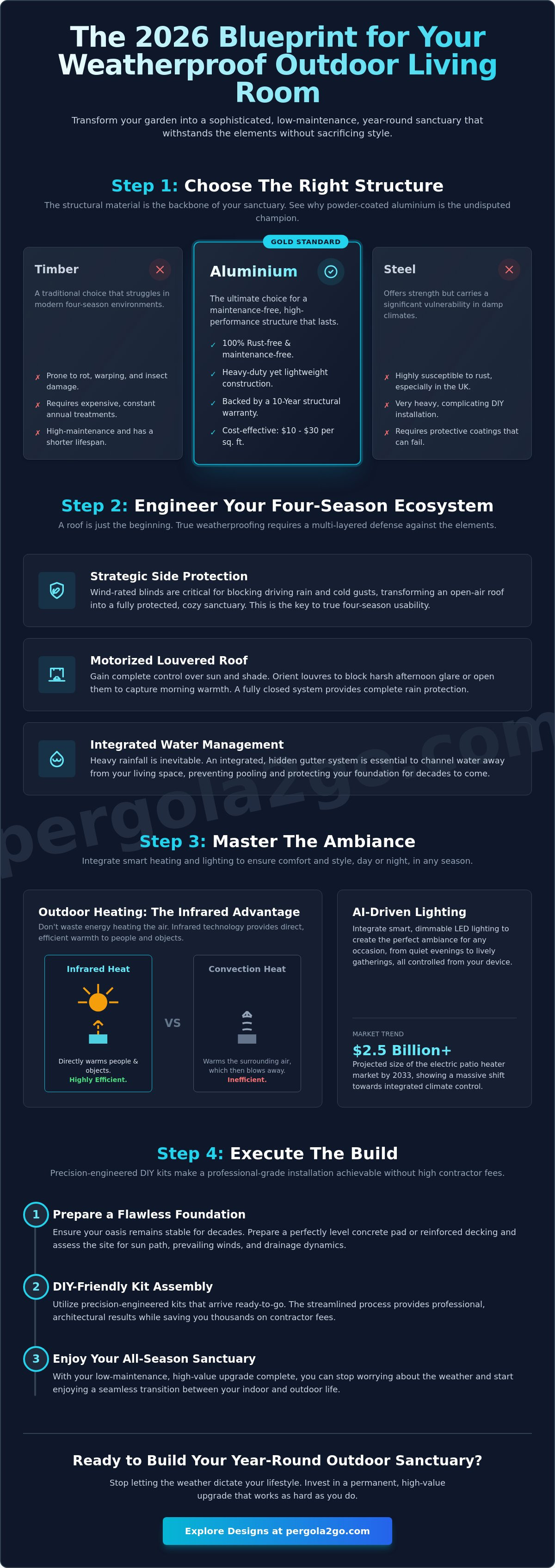
By the end of this guide, you'll know exactly how to build a space that withstands the elements without sacrificing an ounce of style. We'll explore why premium, powder-coated aluminum is the 2026 gold standard for durability, costing between $10 and $30 per square foot; and how to integrate smart heating systems that are part of a market projected to exceed $2.5 billion by 2033. From navigating the latest ASCE 7-22 structural load requirements to choosing AI-driven lighting, we're providing a step-by-step roadmap to a low-maintenance, high-value lifestyle upgrade that works as hard as you do.
Key Takeaways
- Upgrade from high-maintenance timber to powder-coated aluminium to ensure your structure remains rust-free and backed by a 10-year warranty.
- Understand the critical role of wind-rated blinds in blocking driving rain, transforming a simple roof into a fully protected, four-season sanctuary.
- Learn why infrared technology is the gold standard for outdoor heating, providing direct, efficient warmth that convection heaters simply can't match.
- Streamline the process of creating a weatherproof outdoor living room by utilizing precision-engineered DIY kits that provide professional results without high contractor fees.
- Prepare a flawless foundation with our essential checklist for concrete pads and decking, ensuring your new oasis remains stable and level for decades to come.
What Defines a Weatherproof Outdoor Living Room in 2026?
In 2026, the concept of a garden has evolved far beyond a simple patch of grass or a paved patio. Creating a weatherproof outdoor living room is now about building a high-performance, permanent extension of your home's interior. While some might describe these spaces as simple relaxation corners, a true weatherproof sanctuary requires precision engineering. It's the difference between seasonal furniture that you scramble to cover during a storm and an all-weather architectural structure that stands its ground. Modern homeowners are increasingly using these zones as professional garden offices or sophisticated lounges. This shift demands a setup that handles 60mph winds, heavy rainfall, and intense UV rays without flinching. For those seeking inspiration on how to combine durability with high-end design, the projects from BigDecks demonstrate the standard for premium outdoor living spaces.
A genuine four-season space must account for more than just a roof. To be truly "weatherproof" in the UK, your living room needs to manage temperature drops and driving rain simultaneously. It's an engineered ecosystem. You're looking for a structure that offers the same reliability as your indoor lounge but with the breathing room of the outdoors. This means moving away from temporary gazebos and embracing heavy-duty, powder-coated frames designed for longevity.
The Psychology of the Outdoor Sanctuary
There is a profound sense of tranquility that comes from having an outdoor oasis ready at a moment's notice. A permanent structure provides a sense of "place" that temporary setups simply lack. It's about more than just shelter; it's about the pride of homeownership and the mental health benefits of year-round nature access. When your space is built with Pergola designs and materials that prioritize industrial durability, you stop worrying about maintenance and start enjoying the ambiance. This shift creates a seamless transition that elevates your daily lifestyle.
Assessing Your Site for Four-Season Use
To achieve a truly functional space, you must look at your site through a technical lens before you begin. Precision planning ensures your investment pays off regardless of the forecast.
- Prevailing Winds: Identify where the strongest gusts hit your patio. This determines where you'll need wind-rated side screens to maintain internal warmth.
- Sun Path Optimization: Calculate the sun's trajectory across your garden. This allows you to orient motorized louvres to block glare in the afternoon while capturing warmth in the morning.
- Drainage Dynamics: Heavy rainfall is a reality. Ensure your site has adequate drainage or that your structure includes an integrated gutter system to prevent water pooling.
Creating a weatherproof outdoor living room also requires accounting for the inevitable temperature drops. With the electric patio heater market projected to exceed $2.5 billion by 2033, integrating thermal management into your design is no longer an optional luxury. It's an essential component for genuine four-season comfort.
Selecting a Weather-Resistant Structure: The Aluminium Advantage
The foundation of any high-performance garden room lies in its structural integrity. While timber has been a traditional choice for decades, it often fails to meet the rigorous demands of a four-season environment. Wood is porous, meaning it's prone to rot, warping, and the constant need for expensive annual treatments. Steel offers strength but remains vulnerable to rust, especially in the humid or coastal climates found throughout the UK. For homeowners committed to creating a weatherproof outdoor living room, powder-coated aluminium has emerged as the gold standard. It's lightweight yet incredibly heavy-duty, offering a maintenance-free life cycle that timber simply can't match.
Investing in a premium aluminium frame ensures your sanctuary remains pristine for years. These structures are built to withstand 2026's updated structural load requirements, including the latest climate data from ASCE 7-22. With material costs for aluminium ranging between $10 and $30 per square foot, it's a cost-effective way to secure a 10-year structural warranty. Our precision-engineered kits are designed with the homeowner in mind. They arrive ready-to-go, allowing for a DIY-friendly installation that achieves a professional, architectural finish without the high-end contractor price tag. By choosing modern weatherproof materials, you're not just buying a pergola; you're securing a permanent lifestyle upgrade.
Louvered vs. Fixed Roofs: Which is Better?
A fixed roof provides constant shade but lacks the versatility required for the unpredictable British weather. Louvered technology is the primary mechanism for total weather control. Louvered roofs use adjustable slats to balance natural light with total rain protection. When open, they encourage airflow and prevent heat traps. When closed, they become 100% watertight, directing rain into sophisticated, integrated guttering systems that prevent splashes and pooling. For more inspiration on how to style these systems, explore these modern pergola ideas for 2026.
Wall-Mounted vs. Free-Standing Configurations
Your site's layout will dictate which configuration works best for your home. A wall-mounted pergola is ideal for a seamless indoor-outdoor flow. It acts as a direct extension of your kitchen or lounge, making it easier to transport food and drinks for evening hosting. Conversely, a free-standing structure allows you to create a secluded garden oasis away from the main house. Both options provide exceptional stability, provided they are anchored to a solid foundation. If you're unsure which path to take, our aluminium pergola ultimate buyer's guide offers a deeper dive into structural considerations. Browse our precision-engineered collection to see which configuration suits your garden's unique footprint.
Managing Wind and Rain: Strategic Side Protection
A louvered roof provides the ceiling, but in the UK, rain rarely falls straight down. Driving rain and biting winds can quickly turn a sophisticated patio into an unusable damp zone if you haven't considered vertical protection. To succeed in creating a weatherproof outdoor living room, you must think about the space as a 360-degree environment. Side protection isn't just about staying dry; it's about creating a "thermal envelope." By enclosing the sides, you trap the warmth generated by your heating systems, ensuring the space remains comfortable even when the external temperature drops. This structural boundary is what transforms a simple garden structure into a high-performance extension of your home.
Effective side protection requires heavy-duty engineering to handle the UK's unpredictable gusts. High-quality side screens are designed to withstand wind speeds of up to 60mph, providing a sturdy barrier that doesn't rattle or fail. This level of durability ensures your furniture and decor stay protected from the elements throughout the year. When these screens are deployed, they block the wind while still allowing for a sense of connection to the garden, balancing the need for a view with the necessity of a gale-proof sanctuary.
Wind Blinds and Side Screens
When selecting side protection, look for technical specifications that prioritize industrial durability. Premium screens utilize heavy-duty, tear-resistant fabrics that won't sag or stretch over time. The most effective systems use a "zip" track mechanism. This precision-engineered design locks the fabric into the side channels, preventing it from flapping or blowing out of the frame during a storm. Beyond weather protection, garden pergolas with sides provide essential privacy. They turn overlooked patios into secluded retreats, allowing you to enjoy your oasis without the gaze of neighbors.
Decorative Panels for Style and Shelter
If you prefer a permanent architectural look, laser-cut decorative panels offer a sophisticated alternative to fabric screens. These panels are often made from the same powder-coated aluminium as the main frame, ensuring a seamless aesthetic. They work by breaking up the wind's force without completely blocking airflow, which is ideal for maintaining ventilation during the summer months. Mixing and matching screens with decorative panels allows you to create a bespoke look that reflects your personal style. For example, you might use solid screens on the side facing the prevailing wind and decorative panels on the other for a touch of aspirational luxury. This combination ensures your space is both functional and visually striking, providing the perfect ambiance for evening hosting.
Climate Control: Heating and Lighting for Evening Ambiance
Mastering the temperature and light is the final step in creating a weatherproof outdoor living room that feels like a true extension of your home. Many homeowners rely on traditional fire pits or gas convection heaters, but these often struggle in open-air environments. Convection heaters work by warming the air, which quickly drifts away with the slightest breeze. To maintain a sophisticated ambiance throughout the winter, you need a system that targets the people, not the atmosphere. By integrating professional-grade climate control, you ensure your sanctuary is as inviting at midnight in January as it is at noon in July.
Creating a weatherproof outdoor living room requires a shift from temporary solutions to permanent, engineered systems. This transition from the excitement of design to the reality of technical education is where your project gains its professional edge. You aren't just decorating a patio; you're managing a microclimate. High-performance heating and lighting allow you to override the natural clock, turning your garden into a functional space for 18 hours a day, 365 days a year.
The Science of Infrared Heating
Infrared technology is the industry standard for high-end outdoor spaces. Unlike convection, infrared heats objects and people directly through radiant energy. Short-wave infrared heaters convert 92% of energy into heat, making them ideal for open-sided pergolas where wind would otherwise strip away warmth. This direct heat transfer feels like standing in the sun, providing immediate comfort the moment you flick the switch. For the best results, mount your heaters at a 45-degree angle approximately 2.1 to 2.4 meters from the ground. This placement ensures an even "heat envelope" that blankets your seating area without wasting energy on empty space. When combined with the side screens discussed earlier, this setup creates a remarkably stable and warm environment.
Integrated Lighting Solutions
Lighting does more than just provide visibility. It defines the architectural lines of a pergola with a roof. Modern aluminium structures allow for integrated wiring, hiding unsightly cables within the frame for a seamless, high-end look. Dimmable LED kits give you total control over the mood. You can switch from bright, functional light for a family dinner to a soft, warm glow for late-night relaxation. This level of control elevates the space from a simple patio to a luxury retreat. As you move toward the installation phase, remember that all outdoor electricals must be IP-rated for water resistance. Ensure a qualified professional handles the final connection to your home's power supply for long-term safety and reliability.
Ready to bring your vision to life? Explore our range of integrated heating and lighting accessories to complete your year-round oasis.
From Kit to Sanctuary: Executing Your Weatherproof Build
Transforming your vision into a physical reality doesn't require months of construction or a fleet of high-end contractors. The beauty of creating a weatherproof outdoor living room in 2026 lies in the efficiency of the "ready-to-go" modular approach. Modern aluminium kits are designed to be precision-engineered and DIY-friendly, allowing you to achieve professional-grade results in a single weekend. This streamlined process means you can move from an empty patio to a sophisticated sanctuary without the stress of traditional building projects. It's about immediate gratification and long-term durability.
Before the kit arrives, you must ensure your foundation is prepared to handle the structure's weight and the environmental loads. As of January 1, 2026, many jurisdictions have adopted updated building codes, including ASCE 7-22, which require more robust structural load calculations based on recent climate data. Whether you're opting for a concrete pad or reinforced decking, the surface must be perfectly level to ensure the longevity of your investment. A solid foundation isn't just a technical requirement; it's the bedrock of your garden's new lifestyle upgrade.
- Concrete Pads: Ensure a minimum thickness of 100mm for maximum stability.
- Decking: Verify that the joists are reinforced directly beneath where the pergola posts will sit.
- Drainage: Confirm the area has a slight fall to prevent water from pooling around the base of the structure.
Installation Tips for the DIY Enthusiast
Success in assembly comes down to preparation and patience. While the kits are designed for speed, you'll need a two-person team to handle the heavy-duty aluminium beams safely. This ensures precision when lifting components into place and prevents accidental scratches to the premium powder-coated finish. You'll need a standard drill, a high-quality spirit level, and two step ladders to get the job done. The most critical step is ensuring the frame is perfectly square before you tighten the final bolts. If the frame is even slightly off, the motorized louvres won't operate with the seamless, silent motion they're designed for. Take your time with the measurements to ensure a flawless finish.
Maintenance and Long-Term Care
One of the most significant advantages of aluminium over traditional timber is the lack of intensive upkeep. You won't spend your summers sanding, staining, or treating your structure against rot. Aluminium is naturally rust-resistant, and the heavy-duty finish is built to withstand the elements for decades. To keep your oasis looking pristine, a simple cleaning routine with warm, soapy water twice a year is usually enough. It's also wise to clear any seasonal debris from the integrated guttering and louvres after autumn to maintain optimal drainage. This "set and forget" nature is why so many homeowners are making the switch to modern metal designs. Ready to start your transformation? Explore our range of precision-engineered kits and claim your garden back from the elements today.
Reclaim Your Garden for Every Season
Your patio shouldn't be a fair-weather friend. By prioritizing precision-engineered materials and strategic climate control, you've learned that creating a weatherproof outdoor living room is an achievable reality for any homeowner. The shift toward heavy-duty, powder-coated aluminium ensures your sanctuary remains rust-free and maintenance-free for decades. You've seen how infrared heating and wind-rated side screens work together to lock in warmth, turning a simple garden structure into a high-performance extension of your home.
It's time to stop letting the unpredictable British elements dictate your plans. With our 10-year structural warranty and fast UK nationwide delivery, you can build with total confidence in the quality of your engineering. Our rust-resistant powder-coated aluminium designs are ready to help you elevate your lifestyle without the wait. Explore our range of ready-to-go aluminium pergolas and start your transformation today. You've done the research; now it's time to enjoy the tranquility and pride of your new year-round oasis.
Frequently Asked Questions
Do I need planning permission for a weatherproof outdoor living room?
Most installations don't require planning permission because they fall under "Permitted Development" rights. As of 2026, structures must generally remain under 2.5 meters in height if they are placed within 2 meters of a property boundary. If you're creating a weatherproof outdoor living room further away from your fence line, you can often reach a height of 3 meters. It's always best to check with your local council to ensure your project complies with the specific January 1, 2026 building code updates in your area.
Can an aluminium pergola really stay out in the snow?
Heavy-duty aluminium pergolas are engineered to remain outdoors year-round, including during heavy snowfall. These structures are built to meet the latest ASCE 7-22 structural load requirements, which means they can support significant weight without warping or buckling. We recommend leaving the louvres slightly open during extreme blizzards to prevent excessive snow accumulation. This keeps your sanctuary structurally sound even when the temperature drops well below freezing.
How much wind can a pergola with side blinds handle?
A precision-engineered pergola equipped with zip-track side blinds can typically handle wind speeds of up to 60mph. The fabric is locked securely into side channels, which prevents it from blowing out of the frame or flapping during a storm. You should retract the blinds if a storm is forecast to exceed these rated limits to protect the mechanism. This setup provides a secure and calm environment during standard British gales while maintaining the industrial durability of the system.
Is it possible to install a pergola on an existing patio?
You can absolutely install a pergola on an existing patio provided the surface is solid, stable, and level. We recommend anchoring the posts into concrete pads that are at least 100mm thick to ensure the structure remains secure. If your patio consists of thin paving slabs, you might need to lift them and pour a dedicated concrete footing for each post. This creates a permanent base that prevents the structure from shifting or lifting during high winds.
What is the best way to heat an outdoor living room?
Short-wave infrared heaters are the most effective solution for maintaining warmth in an open-air environment. These systems target objects and people directly rather than warming the air, which would simply blow away in the breeze. When you're creating a weatherproof outdoor living room, strategically zoning your heaters ensures that radiant heat is directed exactly where you sit. This provides immediate comfort and ensures your energy isn't wasted on heating the empty garden air.
Are louvered roofs 100% waterproof?
Louvered roofs are 100% waterproof when the slats are in the fully closed position. The interlocking design creates a tight, weather-resistant seal that prevents rain from entering the living space below. Water is then diverted into an integrated guttering system hidden within the horizontal beams and discharged through the vertical posts. This internal drainage ensures your furniture and decor stay completely dry even during the heavy downpours common in the UK.
How long does it take to assemble a DIY pergola kit?
A standard DIY pergola kit typically takes a two-person team between 5 and 8 hours to assemble from start to finish. Most homeowners find they can easily complete the entire project over a single weekend. The process is simplified by our "ready-to-go" modular design and precision-engineered, pre-drilled components. Having a second pair of hands is essential for safely lifting the heavy-duty beams and ensuring the frame is perfectly square before the final bolts are tightened.
Can I add LED lighting and heaters later, or must they be installed at the start?
You can add LED lighting and heaters at any time thanks to the modular nature of our aluminium structures. While installing them at the start allows you to hide the wiring inside the frame during assembly, surface-mounted options are always available for later upgrades. This flexibility allows you to build your oasis in stages. You can start with the core structure and enhance the ambiance with smart technology and climate control as your needs evolve over the seasons.


