

Why spend your evening paying to heat the British skyline when you could be warming your guests instead? It's a common frustration for many UK homeowners who find that traditional heaters simply can't keep up with a brisk evening. You've invested in a stunning outdoor space, but without the right outdoor heater for pergola use, that investment sits idle for half the year. We understand that you want more than just warmth. You want a solution that complements your modern aesthetic without looking like an industrial afterthought.
This guide reveals how to select a high-performance infrared heater that integrates seamlessly with your aluminium structure. You'll discover how to achieve architectural thermal integration, creating a genuine microclimate that heats people directly rather than wasting energy on the surrounding air. We'll walk you through the latest 2026 safety standards and discreet mounting options to ensure your garden room stays inviting from January through December. It's time to stop fighting the elements and start enjoying a permanent lifestyle upgrade.
Key Takeaways
- Learn why radiant infrared technology is the only effective way to maintain a comfortable temperature in open-air structures without wasting energy.
- Master the technical specifications, such as IPX5 ratings and wattage calculations, required to select the ideal outdoor heater for pergola environments.
- Discover how to balance aesthetics and safety by identifying the correct mounting heights and clearances for aluminium louvered roofs.
- Explore how integrating wind blinds can trap radiant heat to create a highly efficient, protected microclimate in your garden room.
- Understand the benefits of selecting heaters specifically engineered for seamless integration with modern, high-grade aluminium pergola kits.
Beyond the Summer: Why an Outdoor Heater Is Essential for Your Pergola
The UK's temperate climate is famously unpredictable. While a sleek aluminium pergola provides the perfect architectural frame for your garden, the British chill often cuts the evening short. Simply put, an open-air structure presents a unique thermal challenge. Conventional heating methods often fail because they rely on warming the surrounding air. In a breezy outdoor setting, that warm air vanishes instantly. Investing in the right outdoor heater for pergola use isn't just about comfort; it's about reclaiming your square footage from the elements.
Many homeowners start with traditional gas "mushroom" heaters, but these are remarkably inefficient for modern louvered structures. They work through convection, heating the air which then rises and escapes through the roof. This results in a massive waste of energy and money. In contrast, short-wave infrared technology offers a precision solution. It creates a microclimate by targeting surfaces and people directly, ensuring you feel the warmth the moment you flick the switch. This shift from heating the air to heating the individual is what makes year-round outdoor living possible.
The Science of Infrared Heat in Open Spaces
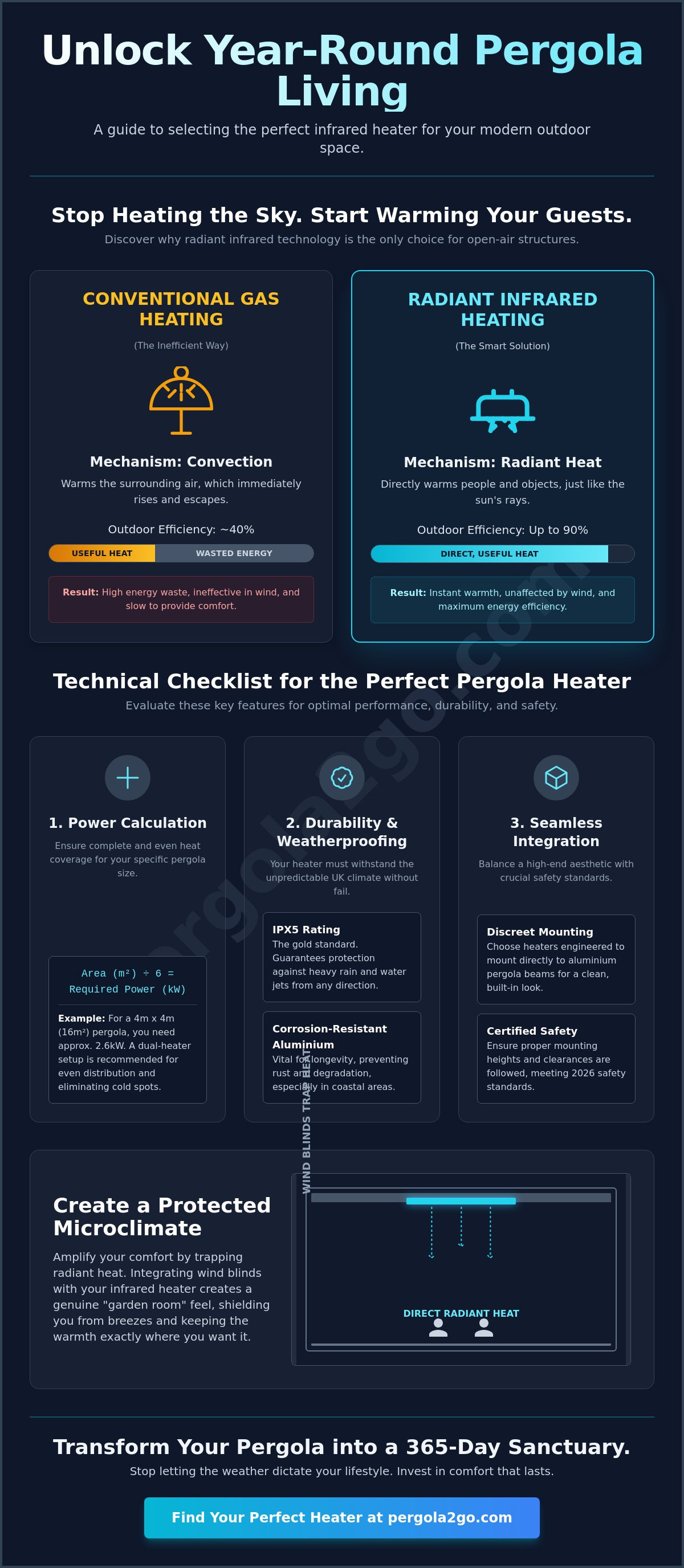
Understanding how infrared heaters work is key to appreciating their efficiency. These devices sit on the electromagnetic spectrum, emitting radiant energy that mimics the warmth of the sun. Unlike gas heaters that might only achieve 40% efficiency in open spaces, infrared models convert up to 90% of their energy into direct heat. This radiant energy travels in straight lines and doesn't rely on the air as a medium. This means wind has zero effect on the warmth you feel. Even on a gusty November evening, the heat remains constant and penetrating, providing immediate gratification without the wait.
Extending Your Outdoor Living Season
A heated pergola evolves from a seasonal luxury into a permanent garden room. It bridges the gap between your interior and the natural world, providing a sanctuary for "outdoor therapy" even when the frost arrives. Imagine enjoying your morning coffee in a crisp, sunlit garden while staying perfectly cosy. It's about versatility. Whether you're hosting a winter dinner party or seeking a quiet retreat, an outdoor heater for pergola integration ensures your property remains functional 365 days a year. This transformation adds significant lifestyle value, turning a simple patio into an elevated, year-round living space that you can take pride in regardless of the forecast.
Key Features to Evaluate: Finding the Right Infrared Heater
Choosing an outdoor heater for pergola use is a balance of aesthetics and technical performance. You aren't just buying a heat source; you're selecting an integrated component for your outdoor living room. To make an informed decision, you must look beyond the exterior design and evaluate the internal engineering that dictates how well the unit will perform in the open air. High-end heating is about creating a consistent, comfortable environment without compromising the sleek lines of your aluminium structure.
Wattage vs. Square Metres: A Practical Guide
Calculating the correct power output is the first step toward a cosy garden room. For a sheltered area, a reliable rule of thumb is to allocate 1kW of power for every 5 to 7 square metres of floor space. If you've chosen a larger 4m x 4m pergola, a single central heater might leave those sitting at the edges in the cold. In these instances, a dual-heater setup is far more effective. This configuration creates an overlapping heat footprint that ensures everyone stays warm, regardless of where they're seated. Keep in mind that mounting height also plays a critical role. As you move the heater higher, the intensity of the radiant rays decreases, so you may need a higher wattage unit to maintain the same level of comfort at ground level.
Durability and Weatherproofing Standards
The UK weather demands a high level of resilience. When evaluating your options, ensure the unit features a corrosion-resistant aluminium housing. This is particularly vital for coastal properties where salt air can quickly degrade inferior materials. The gold standard for outdoor safety is an IPX5 rating. This certification guarantees that the heater is protected against water jets from any angle, allowing it to withstand heavy rain and wind without risk of failure.
Safety is a priority when integrating heat into any structure. Heater safety statistics emphasize the importance of using certified products designed for specific environments. Look for models that include protective grilles or tempered glass covers to shield the heating elements from debris or accidental contact. These features don't just protect the hardware; they provide peace of mind for families and pet owners.
Element Types and Smart Controls
The type of element you choose affects both the atmosphere and the longevity of your heater. Carbon fibre elements are highly regarded for their durability and soft, low-glare orange light. They provide a gentle, deep-penetrating heat that's perfect for long evenings. Tungsten elements, on the other hand, offer a more intense, immediate heat that's ideal for very exposed areas. To truly elevate your experience, consider units with integrated smart controls. Remote controls, smartphone apps, and timer functions allow you to adjust the temperature without leaving your seat. If you're looking for a solution that blends technical excellence with ease of use, explore our range of high-performance infrared heaters designed specifically for modern outdoor living.
Mounting Options and Integration for Aluminium Pergolas
Achieving a professional finish requires more than just picking a powerful unit; it's about how that unit sits within your architectural frame. When you select an outdoor heater for pergola integration, the mounting position dictates the efficiency of your thermal microclimate. Wall-mounted heaters are excellent for structures attached to the home, as they provide a wide, horizontal throw of heat that covers a broad seating area. For freestanding units, ceiling mounting is often the superior choice. This creates a vertical "curtain" of warmth that radiates downward, ensuring heat is distributed evenly across your furniture set without being blocked by high-backed chairs or decorative planters.
Aesthetics play a vital role in maintaining the high-end feel of your garden room. To ensure a seamless look, choose heater housings that match your frame. Anthracite grey and crisp white are the standards for modern aluminium structures, allowing the heater to blend into the beams rather than standing out as a bulky addition. If you're looking for expert advice on choosing a heater, remember that the best installations are those where the hardware is felt but hardly seen. This includes managing your power supply. High-quality aluminium pergolas often feature internal channels or hollow legs, allowing you to route cables discreetly and maintain a clean, wireless appearance.
Protecting Your Pergola’s Structural Integrity
Safety clearances are a critical consideration when mounting heating elements near louvered roofs. While aluminium is exceptionally heat-resistant, you must maintain the correct distance from the roof slats to prevent heat buildup when the louvres are closed. Infrared technology is particularly well-suited for this environment because it doesn't rely on hot air, meaning it won't damage the durable powder-coated finish of your structure. For the most secure fit, use mounting brackets designed to integrate with the T-slot or internal channels of your pergola's beams. This ensures a rock-solid connection without the need for invasive drilling that could compromise the weatherproofing of the frame.
The Case for Integrated Heating Systems
Choosing an integrated outdoor heater for pergola use offers significant advantages over freestanding pedestal models. Freestanding heaters are often unstable in the wind and create significant trip hazards with trailing cables. By opting for a modular, fixed system, you maximize your usable floor space and create a safer environment for guests. A fixed installation also allows for better zone control, ensuring you only heat the specific areas where people gather. For more information on creating a cohesive outdoor space, see our Aluminium Pergola UK: The Ultimate Buyer’s Guide. Shifting from temporary solutions to permanent, integrated heating is the final step in turning a simple patio into a sophisticated, year-round sanctuary.
Maximising Efficiency and Safety in Your Outdoor Space
Creating a warm garden sanctuary is about more than just raw power. It's about how you manage that energy to ensure every watt translates into comfort. To get the most out of your outdoor heater for pergola, you must consider the environment as a whole. Radiant heat is exceptionally efficient, but its impact is amplified when you control the surrounding airflow. By strategically using integrated accessories, you can transform an open patio into a high-performance thermal zone that resists the British chill.
The Synergy of Heaters and Side Screens
Infrared rays heat surfaces directly, but the air inside your structure can still be cooled by a sharp breeze. Integrating wind blinds allows you to create a "still air" environment. This prevents the wind from stripping away the warmth that has been absorbed by your furniture and decking. When you close the louvered roof and lower the side screens, you effectively seal the microclimate. This synergy ensures your heating system doesn't have to work as hard to maintain a consistent temperature. For a deeper look at creating a protected environment, explore our Garden Pergola with Sides: Your Guide to Year-Round Outdoor Living.
Safety is a non-negotiable priority for any electrical installation. Every outdoor heater for pergola must be protected by a Residual Current Device (RCD). This safety switch instantly cuts power if a fault is detected, providing essential protection for your property and guests. While the mounting process is designed for ease, we recommend that the final connection to your home’s power supply is handled by a qualified electrician to ensure full compliance with UK safety standards.
Calculating Running Costs in 2026
Efficiency is a core value for the modern homeowner, and electric infrared units are remarkably cost-effective. You can calculate your hourly expense using a simple formula: Wattage x Cost per kWh = Total hourly running cost. For example, a 2000W (2kW) heater running at current UK energy rates typically costs a fraction of the price of traditional patio gas canisters. You can further eliminate wasted energy by adopting a "Zone Heating" strategy. Only activate the heaters in the specific areas currently in use, rather than warming the entire structure. Using PIR sensors or smart timers ensures your heaters only operate when they are needed, providing immediate gratification the moment you step outside. If you are ready to start your garden transformation, browse our collection of high-performance Aluminium Pergolas and integrated heating kits.
Creating Your Year-Round Sanctuary with Pergola2Go
Transforming your garden into a high-end retreat is a journey of precision and choice. At Pergola2Go, we've simplified this process by creating a range of accessories that work in perfect harmony with our structures. Choosing an outdoor heater for pergola use doesn't have to be a technical headache. Our infrared heaters are designed to match the sleek, modern lines of our louvered kits, ensuring your sanctuary looks as good as it feels. You get the benefit of professional-grade engineering without the complexity of industrial hardware.
Our heaters feature the same high-grade aluminium construction as our frames. This ensures they resist corrosion even in the dampest UK winters. With an IPX5 rating as standard, these units are built to handle direct rain and wind, providing reliable warmth year after year. We've focused on the needs of the modern DIY homeowner. Every component is designed for easy assembly, allowing you to upgrade your environment in a single afternoon. Because we maintain a UK-stocked warehouse, you don't have to wait months for international shipping. Immediate gratification is just a few clicks away.
The Pergola2Go Advantage
We believe in products that last decades, not seasons. Our focus on low-maintenance materials means you spend more time enjoying your space and less time maintaining it. This commitment to quality is backed by our 10-year structural warranty, giving you total peace of mind in your investment. Our heaters are specifically tested to integrate with our Pergola with Roof models. This ensures that the heat distribution is optimized for the louvered ceiling, preventing any risk of damage to the powder-coated finish while maximizing thermal retention. It is a seamless marriage of form and function.
Final Steps to Your Dream Garden
The most successful outdoor rooms are those that address every sense. By combining our infrared heating with integrated LED lighting and wind blinds, you create a truly versatile environment. These modular add-ons allow you to customize your space as your needs evolve. Whether you're hosting a mid-winter dinner or enjoying a quiet autumn sunset, your pergola adapts to you. Our dedicated outdoor heater for pergola kits are ready for national delivery, ensuring you can complete your project without delay. If you have questions about the best configuration for your property, our expert team is ready to provide the guidance you need to finalize your garden transformation.
Ready to Reclaim Your Garden Sanctuary?
You've seen how the right technology turns a seasonal patio into a permanent sanctuary. By choosing short-wave infrared, you ensure that heat reaches people directly, making the British winter a backdrop rather than a barrier. Integrating an outdoor heater for pergola use isn't just a functional choice; it's an investment in an elevated lifestyle that prioritizes comfort and modern aesthetics. You now have the framework to calculate wattage, understand weatherproofing, and create a microclimate that defies the elements.
Our systems are built for durability and ease. With IPX5 weatherproof rated components and a 10-year structural warranty, your outdoor living room is engineered to last for decades. We manage the technical details so you don't have to, offering fast nationwide UK delivery to get your garden transformation moving immediately. It's time to stop waiting for the summer. Start enjoying your garden on your own terms today.
Browse Our High-Performance Infrared Pergola Heaters
Frequently Asked Questions
Can I leave my outdoor pergola heater out in the rain?
You can certainly leave your heater outside if it carries an IPX5 rating or higher. This certification means the unit is protected against water jets from any angle, making it perfectly suited for the unpredictable British weather. Our heaters feature corrosion-resistant aluminium housings that won't rust or degrade when exposed to rain, ensuring your investment remains a permanent fixture of your garden room throughout the year.
How much does it cost to run an infrared pergola heater per hour in the UK?
Calculating the hourly cost is straightforward using the formula of wattage multiplied by your current electricity rate per kilowatt-hour. For a standard 2000W unit, you simply multiply 2 by your provider's kWh price. This method is significantly more cost-effective than using traditional gas canisters, as infrared technology converts up to 90% of its energy into direct, usable warmth for your guests rather than wasting it on the air.
Where is the best place to mount a heater on an aluminium pergola?
The ideal mounting location depends on whether your structure is free-standing or wall-mounted. For a central seating arrangement, a ceiling-mounted position provides the most even, 360-degree heat distribution. If your pergola is attached to your home, mounting the unit on the wall allows for a wide, angled throw of radiant energy across the space. Using the internal channels of the aluminium beams ensures a discreet, professional finish without visible cables.
Do I need a professional electrician to install my pergola heater?
While you can handle the physical mounting of the brackets yourself, you should always use a qualified electrician for the final mains connection. This ensures your outdoor heater for pergola is correctly wired into a dedicated circuit with RCD protection. A professional will also ensure that any cabling is safely routed through the internal channels of the aluminium frame, maintaining both safety and the sleek, high-end aesthetic of your garden room.
Are infrared heaters safe to use under a louvered roof?
Infrared technology is perfectly safe for use with louvered roofs because it heats objects rather than the air. Unlike gas heaters that release rising hot exhaust gases, infrared rays pass through the air without raising the temperature of the aluminium slats significantly. You should still observe the recommended safety clearances to ensure optimal performance and to maintain the integrity of the durable powder-coated finish over many years of use.
Will a 2000W heater be enough for a 3m x 3m pergola?
A 2000W heater is the perfect choice for a 3m x 3m footprint. Based on the standard guidance of 1kW per 5 to 7 square metres, a 2kW unit provides ample coverage for a 9 square metre area. This power level ensures that everyone seated under the structure feels the immediate warmth of the radiant rays, even on a crisp evening, without the need for multiple units or excessive energy consumption.
Can infrared heaters be used with pergola wind blinds?
Using an outdoor heater for pergola comfort alongside wind blinds is the most effective way to create a true year-round sanctuary. While infrared heat isn't blown away by the wind, side screens help by trapping the warmth that has been absorbed by your furniture and decking. This creates a "still air" pocket that makes the environment feel much more substantial and cosy, effectively turning your pergola into a fully functional outdoor room.
What is the difference between short-wave and medium-wave infrared?
Short-wave infrared provides a more intense, immediate heat that is specifically designed for exposed outdoor environments. It penetrates the air more effectively than medium-wave alternatives, meaning the warmth isn't stripped away by sudden gusts of wind. Medium-wave heaters often produce a softer glow but are generally better suited to semi-enclosed or indoor spaces where there is less air movement to contend with.


