

Why do most homeowners surrender their gardens to the frost the moment September arrives? It isn't a lack of desire for the outdoors, but a lack of confidence in their equipment. You might find yourself wondering, are pergola heaters effective enough to actually combat a damp British autumn or a crisp March evening? The truth is that many traditional heaters fail because they focus on warming the air, which simply drifts away with the first signs of a breeze.
We understand the frustration of seeing a beautiful, high-end garden room sit empty for six months of the year. You deserve a space that feels like a permanent extension of your home, not a seasonal compromise. In this guide, we'll show you how modern infrared technology delivers precision warmth that wind cannot touch. You will discover the engineering differences between gas and electric options, learn why radiant heat is the most cost-effective choice for your energy bills, and see how the right setup makes outdoor entertaining a reality regardless of the forecast. It's time to stop checking the thermometer and start enjoying your investment all year round.
Key Takeaways
- Learn why the answer to "are pergola heaters effective" depends entirely on choosing radiant infrared technology over traditional convection methods.
- Discover how combining aluminium structures with integrated side screens creates a thermal barrier that protects your comfort from the wind.
- Identify the specific wavelengths of infrared heat that provide instant, sun-like warmth without wasting energy on the surrounding air.
- Master professional configuration techniques, including the 45-degree mounting rule, to ensure your heat footprint covers every seat.
- Understand how a strategic heating system transforms your garden into a high-value, year-round living space that enhances your lifestyle and property.
Understanding the Science: How Effective Are Pergola Heaters in the UK?
To truly answer the question, are pergola heaters effective, we first need to redefine what effectiveness means in an open garden. In a traditional living room, effectiveness is measured by how quickly the thermostat reaches a set temperature. In an outdoor structure, it's about your personal thermal comfort. You aren't trying to heat the sky; you're trying to create a pocket of warmth that allows you to enjoy a glass of wine on a Tuesday evening in November. This transformation turns a simple patio into a functional "outdoor room" where the boundaries are defined not by glass walls, but by the reach of your heating system. An effective heater doesn't just provide warmth. It provides a reason to stay outside. It justifies the investment in your property by reclaiming square footage that would otherwise be wasted for half the year.
The Mechanism of Radiant Heat
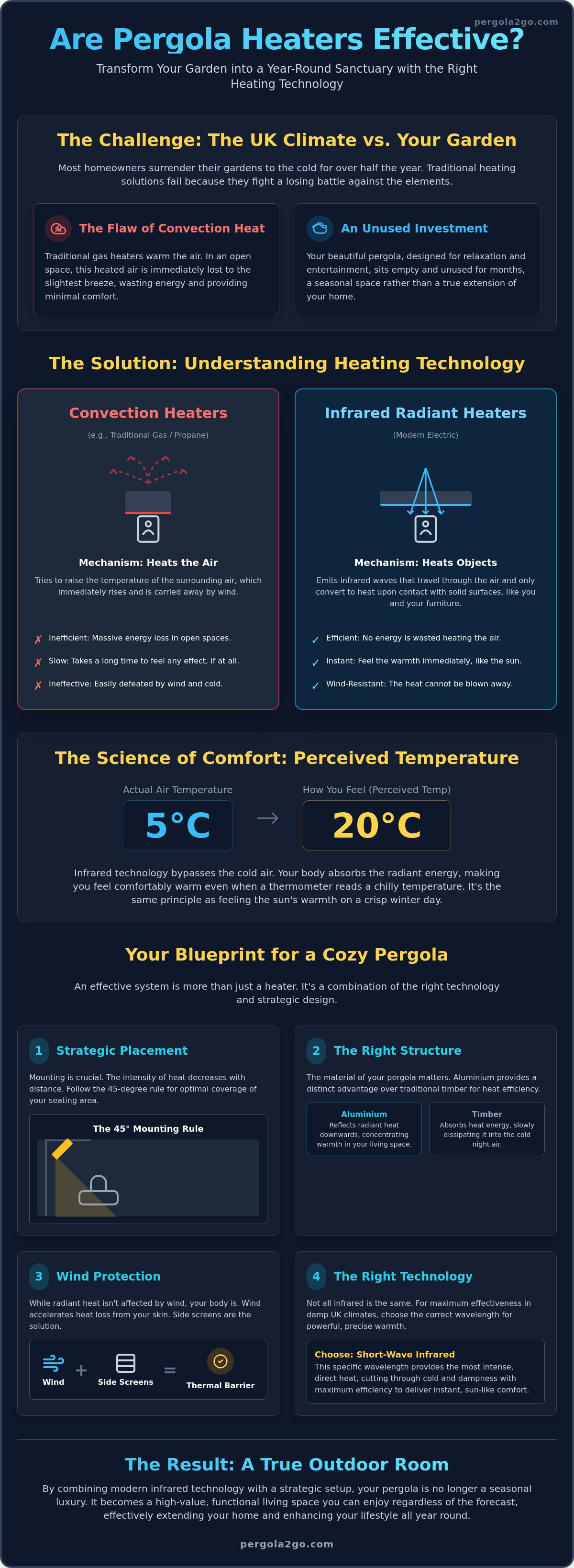
Traditional gas heaters often fail in the UK because they rely on convection. They try to warm the air, which immediately rises or gets swept away by the breeze. An Infrared Heater works differently. It uses electromagnetic waves to transfer energy directly to your skin and the furniture around you. Think about standing outside on a cold, sunny day in February. Even if the air is freezing, the sun feels warm on your face. This is the Science of infrared heating in action. Radiant heat is energy that only converts to warmth upon hitting a solid surface. Because these waves travel through the air without losing energy, they are incredibly efficient for open structures like an Aluminium Pergola.
Why Air Temperature Doesn’t Matter
Outdoor comfort is a game of perception. You might find it surprising that a thermometer under your pergola could read a chilly 5°C, yet you feel as though it's a comfortable 20°C. This is because your body is absorbing radiant energy faster than it's losing heat to the surrounding air. Trying to warm the actual air inside a pergola is a thermodynamic impossibility. Without insulation and airtight seals, that warm air is gone in seconds. By focusing on perceived temperature through infrared technology, you bypass the limitations of the British climate. High-end engineering focuses on short-wave infrared because it cuts through dampness with precision. When you combine this with Wind Blinds or Side Screens, you stop the wind from stripping that warmth away. You create a sanctuary that feels as cozy as any indoor space, regardless of what the weather app says. This is why are pergola heaters effective is no longer a question of "if," but a matter of using the right technology.
Factors That Influence Heating Effectiveness in Open Structures
Understanding the physics of infrared is only the first step. To truly determine are pergola heaters effective for your specific garden, you must consider the environment they inhabit. Radiant heat is powerful, but its performance is heavily influenced by the structure surrounding it. Factors like mounting height play a pivotal role. Due to the Inverse Square Law, the intensity of the heat you feel drops off quickly as distance increases. If you mount a heater too high on a tall beam, the energy dissipates before it reaches your seat. Finding that "sweet spot" in your layout is what separates a lukewarm patio from a cozy outdoor retreat.
Humidity and wind also enter the equation. While infrared waves travel through moisture more efficiently than convection heat, extreme UK dampness can still have a minor impact on energy transmission. However, wind is the true enemy of outdoor comfort. Technical studies on the efficiency of radiant heating in open spaces show that while the heater itself isn't affected by wind, your body certainly is. Moving air accelerates heat loss from your skin through evaporation, making you feel colder even when the heater is running at full power. This is why a holistic approach to your pergola design is essential.
The Aluminium Advantage
The material of your structure changes everything. A high-quality aluminium pergola offers a significant advantage over traditional timber. Wood is a natural insulator that absorbs radiant energy and slowly dissipates it into the night air. In contrast, powder-coated aluminium has reflective qualities that help bounce heat back into the seating area. It's an industrial-grade solution that handles the thermal stress of an Infrared Heater without cracking or warping over time. This makes aluminium the superior choice for anyone seeking a permanent, year-round living space that maintains its aesthetic and structural integrity.
Closing the Gaps: Roofs and Sides
To maximize effectiveness, you need to manage airflow strategically. A louvered roof allows you to close the top of your structure, creating a "heat canopy" that helps trap a pocket of warmer air just above head height. But the most important addition for a truly comfortable space is a garden pergola with sides. By integrating Side Screens or Wind Blinds, you stop cross-breezes from entering the space and stripping away your body heat. This combination of a solid roof and protective sides creates a controlled microclimate where your heating system can perform at its peak. It's the difference between a drafty corner and a true sanctuary. If you want to see how these elements come together, take a look at our integrated pergola solutions designed specifically for the unpredictable British climate.
Infrared vs. Convection: Why Radiant Heat Wins for Outdoor Living
Choosing the right technology is the single most important factor in determining are pergola heaters effective for your garden. If you select a heater that relies on convection, you are essentially trying to warm the entire sky. Gas patio heaters and traditional fire pits work by heating the air around them. In an open structure, that warm air rises and escapes immediately, leaving you with a staggering 80% loss in effectiveness. To maintain comfort, you need a system that bypasses the air entirely. Modern Infrared Heaters convert approximately 92% of their electrical energy into direct, radiant heat. This precision ensures that your investment translates into actual warmth rather than wasted energy.
Understanding how infrared heating works helps you see why it's the superior choice for outdoor living. Unlike gas, which requires fuel storage and constant maintenance, electric infrared is a clean, plug-and-play solution. It's also significantly safer for integrated structures. When mounting a heater to a Wall Mounted Pergola or a Free Standing Pergola, aluminium is the ideal partner. It's a non-combustible material that handles the high thermal output of industrial-grade heating elements without risk. This engineering synergy allows you to place high-performance heat exactly where you need it, creating a professional-grade setup that is both powerful and secure.
Short-Wave Infrared: The Gold Standard
Not all infrared is created equal. Infrared technology is generally categorized into short (quartz), medium, and long wave. Short-wave infrared is the gold standard for outdoor comfort because it's effectively "wind-proof." Its higher frequency allows the heat to penetrate the air with surgical precision. It also offers an "instant-on" benefit, reaching its full operating temperature in less than one second. You don't have to wait 20 minutes for the space to warm up. This immediate gratification makes it a central component of modern pergola ideas, where the goal is to make the transition from indoors to outdoors as seamless as possible.
The Pitfalls of Gas and Fire Pits
While fire pits offer a traditional aesthetic, they are often impractical for a high-end garden room. They create "hot head, cold feet" syndrome, where the heat is intense but poorly distributed. More importantly, using gas or wood-burning fires in a partially enclosed space with Wind Blinds or Side Screens presents serious carbon monoxide risks. Electric infrared eliminates these safety concerns entirely. There are no heavy gas canisters to haul and no messy ash to clear away. You gain a sleek, low-maintenance heating solution that complements the modern aesthetic of your pergola while providing consistent, reliable warmth at the touch of a button.
For homeowners who still utilise gas for other outdoor appliances like BBQs or fire tables, managing fuel logistics efficiently is key; you can discover Gas2Home to learn more about the pros and cons of delivery versus manual pickup.
Maximising Your Warmth: Placement and Configuration Tips
Even the most advanced Infrared Heater will struggle if it's positioned poorly. To truly answer the question, are pergola heaters effective, you have to look at how the energy is distributed across your specific floor plan. You need to calculate the "heat footprint" of your structure. This footprint is the physical area where the radiant waves are most concentrated. For a standard 3m x 3m Aluminium Pergola, a single central heater might leave the corners feeling neglected. This is why we advocate for two smaller heaters over one massive unit. By spreading the source of the warmth, you create a more balanced environment that mimics the natural feel of a heated indoor room.
The 45-degree rule is a professional secret for perfect configuration. When mounting your heaters to the beams of a Wall Mounted Pergola or Free Standing Pergola, angle them at 45 degrees toward the center of the seating area. This ensures the radiant energy hits the people in the space rather than warming the floor or the roof louvres. When you pair this strategic placement with an LED Lighting Kit, the transformation is complete. The visual warmth of the lights combined with the physical warmth of the infrared creates an inviting sanctuary that draws guests in. It's about engineering an atmosphere, not just installing a gadget.
Creating Heat Zones
Think about how you move through your garden. If your pergola houses both a dining table and a lounge area, treat them as separate zones. Position one heater directly over the table and another angled toward the sofa. This "zone heating" approach is far more efficient; you only power the areas you're using. "Cross-firing" heaters from opposite sides is another excellent tactic. By overlapping the beams from two different directions, you eliminate the "cold shoulder" effect and ensure every guest feels the same consistent level of comfort.
Mounting Heights and Safety
Safety and effectiveness must work in tandem. The optimal mounting height for most residential pergolas is between 2.1 and 2.4 metres. This height provides enough clearance to avoid singeing hair while keeping the heat intensity high enough to be felt. Always maintain the manufacturer's recommended clearance distances from louvered roofs and Wind Blinds to prevent heat damage. Because your system is outdoors, professional IP65-rated installation is vital. This rating ensures your electrical work is dust-tight and protected against water, giving you peace of mind during a heavy downpour. Ready to design your perfect layout? Explore our range of integrated heating and pergola systems to find the right configuration for your home.
Creating a Year-Round Sanctuary with Integrated Heating
Investing in a high-quality heating system is about more than just temperature control. It's about shifting your perspective on what your garden can be. When you integrate a professional-grade Infrared Heater into your structure, you aren't just buying a gadget. You are completing a lifestyle system. This approach transforms your Aluminium Pergola into a permanent extension of your home. By effectively adding usable square footage that remains comfortable in October or March, you significantly enhance your property's value. In the competitive UK housing market, a "year-round outdoor room" is a sophisticated asset that sets a home apart from those with standard, seasonal patios.
The psychological benefits of this transition are equally profound. We often find ourselves confined indoors during the UK's "dark months," which can feel restrictive. Having the ability to step into a warm, illuminated garden space provides a vital connection to the outdoors. It offers a sense of tranquility and a fresh environment for entertaining or relaxing, regardless of the frost outside. When people ask, are pergola heaters effective, they are often really asking if the investment will change how they live. The answer is a resounding yes, provided the heating is treated as a core component of the architectural design rather than a late addition.
The Pergola2Go Infrared Solution
Our heating solutions are specifically engineered to complement our modular kits. We've moved away from the bulky, industrial eyesores of the past. Our heaters feature a sleek, low-profile aesthetic that aligns perfectly with the clean lines of a Free Standing Pergola or Wall Mounted Pergola. They meet the rigorous 2026 energy efficiency standards, ensuring that your comfort doesn't come at the expense of excessive electricity bills. To further enhance your home's sustainability, MarGav Solar can provide expert guidance on using renewable energy to power your outdoor lifestyle. Because our system is modular, adding a heater is a straightforward process. The brackets are designed to fit securely to the aluminium frame, maintaining the structural integrity and high-end finish of your garden room.
Your Next Steps to a Cosy Garden
Ready to reclaim your outdoor space? Before you begin your transformation, there are a few practical considerations to keep in mind. First, check your home's electrical capacity. High-performance units often require 2.0kW or more, so ensuring your circuit can handle the load is a vital first step. Next, consider how many zones you need to heat based on your furniture layout. You can browse the full Pergola2Go accessory range to find compatible heaters, Wind Blinds, and LED Lighting Kits that work in harmony. Don't let another season go to waste. Start planning your year-round sanctuary today and discover for yourself just how effective a professional heating setup can be.
Reclaim Your Garden All Year Round
Transforming your outdoor space into a permanent sanctuary is a matter of precision engineering. By choosing short-wave infrared technology and integrating it with a high-quality aluminium structure, the answer to are pergola heaters effective becomes a resounding yes. You've seen how radiant heat ignores the wind, while side screens and louvered roofs create the essential microclimate needed for true comfort. These elements work together to ensure your garden remains a vibrant, usable extension of your home through every season.
At Pergola2Go, we design our systems specifically to withstand the unpredictable British climate. Every structure comes with a 10-year structural warranty, and we offer nationwide UK delivery from our local stock to get your project moving quickly. It's time to stop letting the weather dictate your lifestyle and start enjoying the tranquility of your garden room today. We've thought through every technical detail so you can focus on entertaining and relaxing.
Ready to elevate your home? Browse our range of high-performance Infrared Heaters and Aluminium Pergolas and take the first step toward a warmer, more luxurious outdoor experience.
Frequently Asked Questions
Do pergola heaters work in the wind?
Yes, provided you use short-wave infrared technology. Unlike gas models that warm the air, infrared heaters transfer energy directly to your body. This makes them the only real answer when asking are pergola heaters effective in breezy conditions. To stop the wind from stripping heat away from your skin, we recommend adding Side Screens or Wind Blinds to create a protected microclimate.
How much does it cost to run an electric pergola heater in the UK?
Running costs depend on the wattage of your unit and your current energy tariff. Based on an average UK electricity rate of 34p per kWh from January 2025, a standard 2kW Infrared Heater costs approximately 68p per hour to run. This is significantly more economical than gas patio heaters, which often cost between 60p and £2.00 per hour depending on the fuel type and heater size.
Are infrared heaters safe to use under an aluminium pergola roof?
Infrared heaters are perfectly safe for use with an Aluminium Pergola. Aluminium is a non-combustible material with high thermal resistance, so it won't warp or catch fire like wooden structures might. As long as you maintain the manufacturer's recommended clearance distances from the louvered roof and any Decorative Panels, the heat is directed safely toward the seating area without impacting the structure.
How many heaters do I need for a 3x3m or 4x3m pergola?
We typically recommend two heaters for a 3x3m or 4x3m space to ensure balanced warmth. While a single high-wattage unit might cover the square footage, it often creates "cold spots" for guests sitting at the edges. By mounting two smaller units on opposite beams, you achieve "cross-firing" warmth that covers the entire dining or lounge area evenly without needing to run them at maximum power.
Can I leave my pergola heater outside all year round?
You can leave your heater mounted outside if it has a high IP (Ingress Protection) rating. Look for units with an IP65 rating or higher, which indicates they are dust-tight and protected against water jets. These professional-grade heaters are engineered for the British climate and designed to stay in place through winter, though you should always ensure the electrical connections are housed in a waterproof junction box.
What is the difference between a patio heater and a pergola heater?
The main difference lies in mounting and heat delivery. A standard patio heater is often a floor-standing gas "mushroom" that relies on convection, which is rarely effective in open spaces. A dedicated pergola heater is typically a sleek, wall or beam-mounted infrared unit. These integrated systems are part of a wider lifestyle upgrade, providing instant, directed warmth that complements the modern aesthetic of your garden room.
Do I need a special electrical socket for an outdoor heater?
Outdoor heaters require a dedicated, waterproof electrical supply installed by a qualified professional. Because most effective heaters pull 2.0kW or more, they shouldn't be run off standard indoor extension leads. An RCD-protected circuit and a high-quality outdoor socket are essential for safety. This ensures your LED Lighting Kit and heating system can run simultaneously without overloading your home's electrical capacity.
Will a heater damage the powder coating on my aluminium pergola?
A high-quality heater will not damage the powder coating if it is installed correctly. The powder-coated finish on our aluminium kits is designed for industrial durability and can withstand significant thermal stress. By following the 45-degree mounting rule and keeping the heating element at the correct distance from the frame, you protect the aesthetic finish while enjoying maximum warmth in your sanctuary.


